Walk into a busy commercial building in Sacramento, CA, and you’ll quickly notice how much the indoor environment affects everyday operations. Maybe employees are struggling to concentrate because conversations travel between offices, or your warehouse gets unbearably hot during summer afternoons. Perhaps your heating and cooling equipment runs constantly, yet certain work areas never seem comfortable. These problems might appear unrelated, but the insulation inside your building can influence both temperature control and how sound moves through the space.
Choosing between commercial spray foam and fiberglass insulation depends on your building’s construction, energy efficiency goals, and acoustic requirements. Spray foam can provide effective thermal insulation and air sealing, while fiberglass is particularly useful for insulating wall cavities and contributing to sound control. Neither material is automatically the best choice for every commercial application.
Here are several important considerations for Sacramento business owners:
-
Spray foam insulation can reduce unwanted air leakage and heat transfer when installed as part of a properly designed building assembly.
-
Fiberglass insulation can improve thermal resistance and support sound control in commercial interior walls and ceilings.
-
Sacramento’s hot summers and cool winters make effective insulation important for maintaining comfortable work environments.
-
Offices, warehouses, and industrial facilities throughout the Central Valley often have different acoustic and thermal requirements.
-
Professional insulation evaluations help determine whether spray foam, fiberglass, or a combination of materials is appropriate.
At 5 Star Performance Insulation, Inc., we bring 30 years of industry experience to helping commercial property owners improve their buildings. Our customized insulation and soundproofing solutions serve businesses throughout Sacramento, the Central Valley, and the Sierra region, with a focus on practical improvements that support comfort, efficiency, and everyday operations.
What’s the Difference Between Commercial Spray Foam and Fiberglass Insulation?
The primary difference between commercial spray foam and fiberglass insulation is how each material is installed and performs within a building assembly. Spray foam expands after application and can help create an air barrier, while fiberglass typically uses fibers arranged in batts or loose-fill material to resist heat transfer and absorb sound.
How Commercial Spray Foam Insulation Works
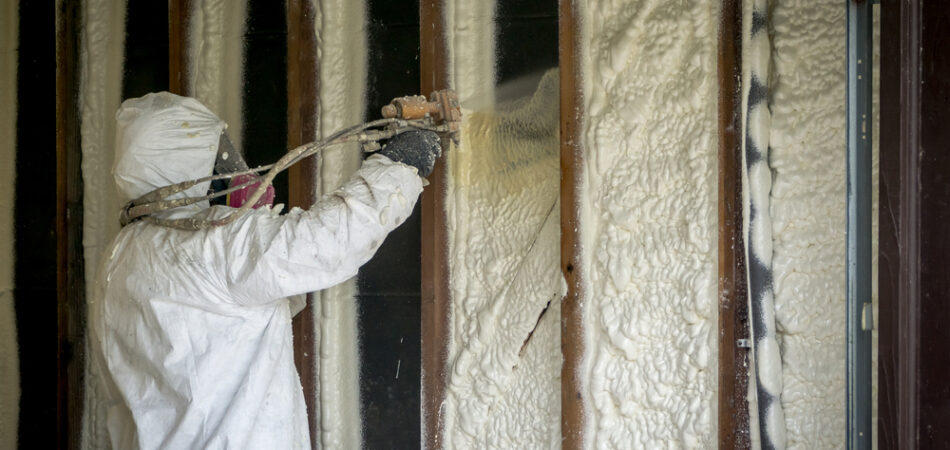
Spray polyurethane foam is applied directly to compatible building surfaces, where it expands and cures. Depending on the product, it can provide thermal insulation while sealing certain gaps that allow unwanted air movement.
Commercial applications may include roof assemblies, exterior walls, and other areas where air leakage and temperature control are major concerns.
There are 2 primary spray foam categories:
-
Open-cell spray foam: A lower-density material that provides thermal resistance and can contribute to sound absorption within certain assemblies.
-
Closed-cell spray foam: A denser material offering higher thermal resistance per inch and, at appropriate thicknesses, low water-vapor permeance.
Both materials require professional installation and appropriate consideration of building codes, fire protection, and moisture management.
How Fiberglass Insulation Works
Fiberglass insulation uses fine glass fibers to create pockets of air that resist heat transfer. It’s commonly installed in wall cavities, ceilings, and other framed building assemblies.
Because fiberglass is a fibrous material, it can also absorb sound energy within interior partitions. This makes it useful in offices, conference rooms, and other spaces where acoustic comfort is important.
However, fiberglass alone doesn’t serve as a complete air barrier. Buildings with significant leakage may need additional air sealing to achieve the desired energy performance.
Which Insulation Is Better for Commercial Soundproofing?
Fiberglass insulation is often a practical choice for commercial soundproofing projects involving interior walls, while appropriately selected open-cell spray foam can also contribute to acoustic performance. However, the effectiveness of either material depends on the entire wall or ceiling assembly rather than insulation alone.
Why Office Soundproofing Requires More Than Insulation
Imagine managing a professional office near Downtown Sacramento where conversations from neighboring rooms regularly interrupt employees. Adding insulation inside partitions may improve sound control, but it won’t necessarily eliminate the problem.
Sound can travel through doors, ceiling spaces, duct openings, and gaps around building components.
Effective workspace soundproofing in Sacramento may require a combination of cavity insulation, appropriate wall construction, acoustic sealing, and other sound-control measures.
Understanding Sound Absorption and Sound Blocking
Sound absorption and sound isolation are related but different goals.
Sound absorption reduces sound reflections within a space. Sound isolation limits how much noise passes from one room into another.
Fiberglass insulation can contribute to both when incorporated into appropriate assemblies, but blocking sound between rooms also depends heavily on wall mass, airtightness, and structural connections.
Laboratory testing published by the North American Insulation Manufacturers Association has shown that different cavity insulation materials can produce relatively small differences in sound transmission ratings when tested in otherwise similar wall assemblies.
For Sacramento offices, this means choosing insulation based solely on its advertised soundproofing qualities may overlook other important design considerations.
Where Acoustic Insulation Can Make a Difference
Commercial sound control is especially valuable in spaces where privacy, concentration, and communication matter.
Common applications include:
-
Conference rooms requiring improved speech privacy.
-
Professional offices with shared interior walls.
-
Medical and administrative workspaces.
-
Break rooms adjacent to quiet work areas.
-
Commercial properties with multiple tenants.
-
Interior partitions separating work areas from equipment rooms.
Our approach considers how a space is used before recommending insulation materials and acoustic improvements.
Which Material Provides Better Thermal Performance for Sacramento Commercial Buildings?
Spray foam can provide higher thermal resistance per inch than many fiberglass products, particularly when closed-cell foam is used. However, fiberglass can also deliver effective commercial thermal insulation when installed at the appropriate thickness and incorporated into a properly designed building envelope.
Why Air Sealing Matters for Energy Efficiency
Insulation reduces heat transfer, but uncontrolled air leakage can still undermine a building’s thermal performance.
For example, a commercial facility with substantial gaps around roof penetrations or wall connections may experience unwanted heat gain during Sacramento’s summer months.
Appropriately installed spray foam can help address air leakage and insulation needs simultaneously in certain applications. Fiberglass installations may require separate air-sealing measures to provide comparable control of unwanted airflow.
Managing Central Valley Temperature Changes
Sacramento’s Mediterranean climate brings hot, dry summers and cooler, wetter winters. These seasonal changes can make temperature control challenging in commercial buildings with inadequate insulation.
Warehouses in West Sacramento and distribution facilities near the Interstate 5 corridor may experience significant heat gain through large roof surfaces.
Meanwhile, professional offices in Rancho Cordova or Roseville may struggle with uneven indoor temperatures caused by insulation gaps or air leakage.
Improving commercial energy efficiency starts with understanding where heat enters and leaves the building, rather than automatically selecting one insulation product.
Understanding R-Value and Installation Quality
R-value measures a material’s resistance to heat flow. Higher values generally indicate greater thermal resistance, although overall building performance depends on more than the insulation’s stated rating.
Poor installation, thermal bridging through framing, and gaps around building components can reduce the effectiveness of an insulation system.
Our commercial insulation evaluations consider these factors when helping property owners determine which materials and installation methods are appropriate.
What Factors Should Commercial Property Owners Consider Before Choosing Insulation?
Commercial property owners should consider building use, construction type, existing insulation, acoustic requirements, moisture conditions, and applicable code requirements before choosing spray foam or fiberglass. These factors influence which insulation system can deliver the most appropriate balance of thermal performance, sound control, and long-term durability.
Match Insulation to the Building’s Purpose
A professional office with multiple meeting rooms has different needs from a warehouse storing temperature-sensitive products.
For office environments, speech privacy and consistent indoor temperatures may be important priorities. Industrial facilities may place greater emphasis on roof insulation, air leakage control, and reducing heat gain across large interior spaces.
An effective insulation plan should reflect how the building operates throughout the year.
Consider Moisture and Building Assembly Requirements
Commercial buildings need insulation systems that work with their existing construction and moisture-management design.
Improper material selection can contribute to condensation problems, particularly when insulation changes how heat and moisture move through walls or roofs.
Professional assessment is especially important before applying spray foam to existing roof assemblies or enclosed spaces where moisture conditions aren’t fully understood.
Understand California’s Commercial Building Standards
California’s 2025 Building Energy Efficiency Standards took effect on January 1, 2026, for applicable new construction, additions, and alterations.
These requirements can influence insulation selection, energy performance, and other aspects of commercial building projects. The City of Sacramento also applies the 2025 California Building Standards Code and applicable local amendments to new permit applications.
Owners should consult qualified professionals to determine which requirements apply to their proposed work rather than assuming every insulation upgrade follows identical rules.
What Are the Signs Your Commercial Building Needs Better Insulation?
Common signs that a commercial building needs insulation improvements include uneven temperatures, excessive heating and cooling demand, persistent drafts, and unwanted noise between work areas. These symptoms may indicate missing insulation, inadequate air sealing, or building assemblies that no longer meet the property’s operational needs.
Watch for the following concerns:
-
Hot or cold work areas: Certain rooms remain uncomfortable despite normal HVAC operation.
-
High utility expenses: Heating or cooling costs appear excessive for the building’s usage.
-
Noticeable drafts: Air moves through gaps around exterior building components.
-
Poor speech privacy: Conversations are easily heard through interior partitions.
-
Excessive warehouse heat: Large workspaces become uncomfortable during summer afternoons.
-
Visible insulation gaps: Accessible wall or roof areas show missing or deteriorated materials.
-
Condensation concerns: Moisture appears on interior surfaces or within accessible assemblies.
These conditions don’t automatically establish that insulation is the only problem. However, they provide useful starting points for a professional evaluation.
For businesses throughout Sacramento County, addressing insulation deficiencies can support more comfortable workplaces and potentially reduce unnecessary energy consumption.
How Do You Choose Between Spray Foam, Fiberglass, or a Combined Insulation System?
Choosing between spray foam, fiberglass, or a combined insulation system requires identifying the building’s most important performance goals. Spray foam may be appropriate where air sealing and thermal resistance are priorities, while fiberglass can be especially useful in interior assemblies designed for acoustic control.
When Spray Foam May Be the Better Fit
Spray foam may be appropriate for commercial applications involving irregular surfaces, air leakage concerns, or assemblies requiring substantial thermal resistance within limited space.
The selected foam type, installation thickness, fire protection requirements, and moisture conditions must all be evaluated before installation.
When Fiberglass May Be the Better Fit
Fiberglass can be a practical option for framed commercial walls, ceilings, and interior partitions.
It’s particularly worth considering when a building needs thermal insulation alongside acoustic absorption within wall cavities.
For office renovations in Elk Grove, Folsom, and surrounding communities, fiberglass may be part of a comprehensive sound-control strategy.
When Combining Materials Makes Sense
Some commercial properties benefit from using different insulation materials in different areas.
For example, a building might use spray foam in selected exterior assemblies where air sealing is important while incorporating fiberglass in interior partitions designed to improve speech privacy.
At 5 Star Performance Insulation, Inc., we help businesses explore customized solutions based on actual building conditions rather than assuming every workspace requires the same insulation material.
[Contact Us to Discuss Commercial Insulation Options]
Frequently Asked Questions About Commercial Insulation in Sacramento
Is spray foam or fiberglass better for commercial insulation in Sacramento?
Both materials can provide effective commercial insulation, but the better choice depends on the application. Spray foam can offer insulation and air-sealing benefits, while fiberglass is useful for thermal resistance and acoustic absorption in framed assemblies. A professional evaluation can help identify the appropriate solution.
Does fiberglass insulation provide better office soundproofing than spray foam?
Fiberglass is frequently used in acoustically designed interior partitions, but it isn’t automatically superior in every application. Wall construction, airtightness, and other assembly details significantly influence sound isolation, making a complete acoustic strategy more valuable than material selection alone.
Can spray foam insulation reduce commercial energy bills?
Spray foam may help reduce commercial heating and cooling expenses by improving thermal resistance and limiting unwanted air leakage. Actual savings depend on existing building conditions, insulation coverage, HVAC operation, and installation quality, so results should be evaluated on a property-specific basis.
What insulation works best for Sacramento warehouses?
Warehouse insulation needs depend on roof construction, building size, occupancy, ventilation, and temperature-control requirements. Spray foam or fiberglass may be appropriate in different assemblies, but a professional assessment is important for identifying the most effective way to address heat gain and energy loss.
Does commercial insulation help control noise between offices?
Yes, appropriately selected insulation can contribute to sound control between offices, particularly when installed inside well-designed wall assemblies. However, doors, ceiling connections, and gaps around building components must also be considered when improving speech privacy.
Are California building codes important when upgrading commercial insulation?
Yes, applicable California building codes and energy standards can affect commercial insulation projects. The 2025 Building Energy Efficiency Standards became effective January 1, 2026, and project-specific requirements depend on the scope of work, building conditions, and local jurisdiction.
Can commercial buildings use spray foam and fiberglass together?
Yes, commercial buildings can use spray foam and fiberglass in different assemblies or as part of appropriately designed combined systems. The installation must account for thermal performance, moisture management, fire protection, and applicable building requirements to ensure the materials work together effectively.
Why should I schedule an on-site commercial insulation evaluation?
An on-site evaluation helps identify existing insulation conditions, air leakage concerns, acoustic problems, and building-specific requirements. This information allows professionals to recommend suitable materials and installation methods without relying on assumptions about how the property was constructed.
Create a More Comfortable, Efficient Sacramento Workspace
The right commercial insulation can do much more than help control indoor temperatures. It can contribute to quieter offices, more comfortable workspaces, reduced energy waste, and a building environment that better supports daily operations. Whether you manage a professional office in Sacramento, a warehouse in the Central Valley, or a commercial property near the Sierra foothills, choosing between spray foam and fiberglass should begin with understanding your building’s actual needs. By considering both thermal and acoustic performance, you can make improvements that deliver practical value beyond the initial installation.
At 5 Star Performance Insulation, Inc., we bring 30 years of industry experience to commercial insulation projects throughout Sacramento and surrounding regions. Our approach focuses on evaluating building conditions, understanding how each space is used, and recommending solutions that support the property’s performance goals. From spray foam insulation to fiberglass installations and customized soundproofing improvements, we’re here to help business owners create more comfortable, efficient environments for employees and customers.